Wednesday, August 11, 2010

Naked or Nude?

It must be one of the most 'frequently asked questions' in art. Whole books have been written on the subject, and it is one of art's most explored and enduring themes. So what actually is the difference between 'naked' and 'nude'? In seeking an answer for myself, rather than diving into my own library, I'll see if I can come up with some of my own ideas with the help of artists whose treatment of this theme I particularly enjoy.

Dutch Artist George Hendrik Breitner called his painting (above) Seated Half-Nude. His model is 'half-nude' because the artist shows the woman in the act of removing her chemise - an intimate moment. We might normally think that with such a private gesture she would be 'half-naked', and yet Breitner's title alone tells us that she is 'nude', and not 'naked'. Where does the difference lie? For me, it lies in the artist's own attitude, and in his treatment here of the painting itself. Breitner's brushwork is so chiselled and monumental, the forms so sculpted in paint, that he lifts his model away from the everyday through the sheer force of his artistry. The woman whom we see in the canvas is at the same time both an individual - the artist's model - and a more universal 'everywoman': a created form which emerges from the paint in slabs of light and shadow. It is this 'more than the everyday world' aura that makes this woman 'nude'.

This study (above) by contemporary digital artist Craig Mullins displays the same freedom of brushwork - although in this case the artist's 'brush' is a digital one. And Mullins, every bit as much as Breitner before him, is 'at work' here. We feel in the brush lines the striving to understand and describe the planes of the model's body: the arch of the back, the skin stretched taught below the rib cage. The artist is not out to capture feminine beauty, but to reach an understanding of the forms which the model's anatomy describes. And again, as with Breitner's model, Mullins is little concerned with a portrait of a specific individual. The woman's face is articulated with the same rough but incisive brushwork as the rest of the figure.

With the treatment of the nude by Boris Zaborov (above) we are in a radically different setting. Here this removal of the figure from the everyday world is pushed even further by the artist's use of a neutral background. It could be anywhere, at any time and place. Contradictorily, Zaborov's model is a specific individual, her face anything but anonymous. She gazes steadily out at us from her drifting world, as if afloat in a passing dream.

But why need the figure be nude at all? Another often-asked question. Different artists will give different reasons, but my own reaction is again to do with this removal from the everyday. The clothes we wear express much, both about who we are as individuals, and about the time and the place in which we live. For this reason, models who are fully-clothed become 'portraits' almost by default. Clearly, with a nude model there must be another factor at work.

In a very real sense, to step out of one's everyday clothes is to step out of time - to remove oneself from any context with the everyday world. To be nude is not to be naked. It is for this very reason that for a model to be nude can prove to be an empowering experience. Javier Valhonrat's composition (above), from his Possessed Space series, is a clear example. However 'boxed-in' the artist has chosen to portray her, this model in her nudity has all the freedom to occupy an 'eternal now'. For her to have worn even so much as basic underwear would have looked downright ludicrous, and this is what we sense.

So if all these images are what being 'nude' is about, and if we can define it through these examples, where does that leave 'naked'? If nudity removes someone from the everyday, then nakedness must do the opposite. And indeed: you are naked if you are about to climb into bed with your lover. You are naked if you are about to step under the shower. And if you as a model leave your clothes in a neat pile on a chair of the artist's studio, and step forward with the thought that you are serving the needs of art, then with that step you leave the everyday world to become empoweringly nude!

Thursday, July 1, 2010

In Sunlight and Shadow

Two robed men engaged in conversation are about to descend a wide flight of steps, to the sides of which friezes of winged angels swirl and flow around the pillars that the men are about to pass between. Both the men and the steps are bathed in bright sunlight, and the scene seems at first idyllic. But behind the two figures rises an impenetrable wall of tall Lombardy poplars, their shadows so dense that it seems almost as if we are staring into the darkness of space. The work's title confirms the foreboding. This is Steps to the Tomb (below), by the American illustrator Franklin Booth.

Like his fellow-countryman Maxfield Parrish, who also was active in the 1920's, Booth strove to create worlds redolent with the romance of a sunlit age that never was. But something in Booth’s makeup kept pulling him towards darker regions; his compositions so often feature tombs, burials, dark interiors, walls of shadows too dark to penetrate. To what extent Booth himself was aware of this hankering after the darkness is unclear; what is certain is that his body of work, executed almost entirely in chiselled pen strokes and black ink, is masterful in the range of tones and textures which he created with his limited choice of medium.

Even in small details of his work (the footer of a decorative border, above), there is a reaching out, a gesture of longing, that we feel will go unrequited. Who are these beseeching robed figures? We do not know, and the artist does not tell us. At times Booth's subject matter is more direct, as in Burial (below). Here the composition is - quite literally - half in shadow, half in light. To the right: towering sunlit spires and a congregation of figures emerging from a walled garden. To the left: darkness and shadow, as a priest reads the burial service while mourners contemplate a casket and the mysteries of mortality. Ashes to ashes, and dust to dust, reads the tomb's inscription.

With The End of the Way (below), we have crossed the threshold. Booth actually takes us beyond death to the realm that awaits. The robed soul, airily floating on tiptoe, is received by a bearded angel to be guided further. In the background, figures on the path are still approaching, dwarfed under towering piled cumulus.

In The Healed Ones (below), the artist carries us even further into the beyond. Souls drift through the airy spaces as light as the clouds behind them. In the foreground, the 'healed ones' of the work's title are welcomed by other heavenly guides. Booth's masterful pen style is here very apparent. The face and arms of the central female figure are described entirely with varying thicknesses of continuous pen lines.

This device of the artist's of setting foreground figures against distant backgrounds is abandoned in The House of Rimmon (below). Here the groups of figures are distant and anonymous, as we are led through layers of foreground shadows into sunlight and then back into far shadows again. Booth's chiselled linework seems here almost to make the shadows come alive and drift like smoke up to the building's vast roof. It could be the stage set of an opera.

Franklin Booth was in one sense a jobbing illustrator. He made his living producing line drawings to illustrate articles for the magazines and periodicals of his day - Good Housekeeping, Scribner's Magazine, and others. Sometimes his work was produced for individual books, as with his vignette for The Flying Islands of the Night (below), by James Riley.

What sets Booth's work apart is his truly masterly pen technique, with which he described forms and textures, light and shadows - and even a suggested effect of colour - through his pen alone. And there is a darkness there which is the darkness that leads to the tomb. But the artist also carries us beyond these shadowy places to show us other realms. Death, Booth seems to wish to reassure us, is not the end of the way.


The images for this post were made from scans taken from the book The Art of Franklin Booth, which is itself a 1976 facsimile reprint edition of a tribute to Booth published originally in 1925. This much-treasured book has been on my bookshelf for the last thirty-odd years, but I learned only recently from the Internet that this facsimile apparently is even more scarce than the original, with only thirteen known copies catalogued! So as I now realize, I own the fourteenth, and this post therefore reflects a homage to Booth’s art more rare than I myself was aware of at the time that I compiled it.

Friday, May 28, 2010

The Tainted Lips of Angels

It is not quite what we expect. We see familiar-enough elements here - the background of decorative blooms, the two sublime faces in profile, the haloes, and the open book which these other elements suggest is a hymnal (below). All of these combine to convey something angelic, saintly and devotional. And yet the woman in the foreground (and therefore presumably the second woman behind her) is naked. Why this should be so can only be *answered by saying that this was the way in which the artist Louis Welden Hawkins chose to portray her in his painting The Haloes. Why, then, is this element disconcerting?

The language of art has encouraged us to associate the portrayal of haloes and hymn books with religious devotion. Bare breasts generally are not considered to be part of this mix. And yet here those elements are seen together. Whether we consciously think of it in this way or not, Hawkins' painting subtly challenges us to redefine the way in which we might regard such religious iconography. Had the artist opted for a simple willful blasphemy (as others such as Felicien Rops have done), then it might be both more offensive, more explainable - and perhaps less interesting. And yet there is nothing of that here. The two faces express only demure devotion (detail, below).

Hawkins' painting seems to strand us in a paradoxical no-man's-land between the sacred and the secular. It is orthodoxy passed through a filter of paganism. A year later it seems that paganism gained the upper hand in the artist's Autumn (below). Here the woman appears comfortably to belong to the natural world. Her eyes are closed in the breeze that bends the rushes, and that caress is carried along the horizontal watery reflections in the background to lift her floating hair. Perhaps Hawkins intended his figure to express a nature spirit, although even if she is human then she surely has one foot in such invisible realities.

In Autumn, the element of nakedness belongs with the classical world of nymphs and Arcadian glades. But the artist is not yet done. With Innocence (below) we are presented with yet a third type of nakedness, as Hawkins continues to ring his subtle changes on this theme. As in The Haloes, there are two naked women portrayed, but this time the theme is of innocence and temptation.

The background (detail, below) portrays in a faux-woodcut style reminiscent of Albrecht Dürer's works the whore of Babylon from the Book of Revelations, holding the poison chalice of abominations and riding the seven-headed beast. The partially-hidden woman with writhing Medusa-like hair - evidently the temptress - offers a symbolic sphere/apple to the innocent, who with a Latin crucifix around her neck eyes the sphere wonderingly.

Ever-mysterious, the artist portrays this crucifix-wearing woman of naked innocence with her hands crossed beneath her breasts. She holds two olive branches, while the lilies in the foreground underscore the symbolic language of pure unblemished innocence. But the expressions of the two women - the temptress and the innocent - seem almost interchangeable. Can innocence 'corrupt' the fallen, as much as the other way around? Far from being curiosities of art symbolism, Louis Welden Hawkins offers us in these three depictions of women in their nakedness unexpected depths of meaning and interchanges of roles. And these women are naked, rather than nude, although what that difference actually is I'll maybe save for another time!


Artist: Louis Welden Hawkins
Work: The Haloes, 1894
Medium: Oils
Location: Private collection, Paris

Artist: Louis Welden Hawkins
Work: Autumn, 1895
Medium: Oils
Location: Victor Arwas collection, London

Artist: Louis Welden Hawkins
Work: Innocence, 1895
Medium: Oils
Location: Van Gogh Museum, Amsterdam

*What Hawkins had in mind is more fully answered by a text that once was a part of the painting's original frame but which has now been lost, which read: 'They sing the songs of angels with lips still tainted by earth.'

Sunday, April 25, 2010

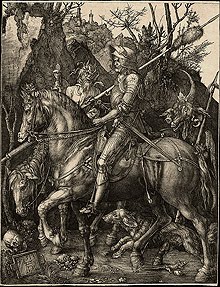
The Knight, Death and the Devil

In full Gothic *armour a knight rides purposefully through a rocky ravine (below). His gaze is fixed firmly upon the way ahead, denying himself the distractions that might lie to either side of his chosen path. Under the very hooves of his steed a lizard scuttles to safety. On the stump of a tree lies a human skull, a grim reminder of the folly and illusion of human vanity. A hound, the knight’s faithful companion on his lonely journey, runs alongside.

The knight is escorted or harrassed by two beings: on the knight’s right the figure of Death raises his hourglass (below), reminding the knight that his mortal days are already numbered and noted. Death’s mount, a scrawny nag, wears a bell around its neck: both the bell and the hourglass convey the passing of time. Behind the knight strides the horned and cloven-hoofed Devil, shouldering a pikestaff.

In his portrayal of the figure of Death, the artist has avoided the conventional ‘grim reaper’ approach. We see here no skeletal hand clutching a scythe; Dürer’s treatment is more tied to grim reality, and the more compelling for it. On the face the dried skin stretches taughtly away from the bone, exposing the skull beneath. Medusa-like serpents writhe and coil, entwining themselves around the crown of Lord Death, although here their appearance has more of the worms of the grave than of scaled and glittering snakes. The matted and straggling pale hair and beard which frame the terrible face are portrayed with the unflinching conviction of a 16th century observer who had encountered such a face often enough, perhaps beside some infrequently-used country road, and certainly on a gibbet.

As with Dürer’s depiction of Death, his Devil as well denies us the option of a comfortable way out (above). There is nothing to snigger at here; no hint of capering caricature which allows us reassuringly to say to ourselves, ‘see, he’s not real after all…’. On the contrary, Dürer has forced in front of our gaze a horror so minutely observed in its detail that it presents the impression that it almost could be classified by science. From the bizarre curving horn that arcs above its head to the grotesque drooping wattles which hang beneath its grimacing snout, every changing texture of horn, hair, flesh and fangs has been captured with the same apparent accuracy of observation and fidelity to reality that the artist used to portray the exotic animals which he later encountered in the Antwerp Zoo. Even the rolling-eyed squint seems unnerving rather than comical: is the Devil looking directly at us, or not? When the Devil looks like this, we may hope that his attentions fall elsewhere.

With the creation of The Knight, Death and the Devil, Dürer’s engraving burin appears almost to have taken on a life of its own, seeming thoroughly at home among this controlled churning of matted hair and metal, of rock and bone and stunted vegetation. The Devil’s crescent horn almost scoops the background wall of rock along with it in a fluid wave of engraved curves. The neck muscles of the knight’s horse seem more sculpted than engraved (above).

Dürer's house in Nuremberg was not far from an *armourer's, and the artist would have seen such knights in life. His watercolor study (above) clearly served the artist as a reference for his engraving. Although it has been suggested that the idea of the noble knight had by Dürer's time declined, this is only partly true. Knights always were a *mercenary class, even something of a rabble, and our own ideas of chivalry belong to the pages of romantic fiction.

The statuesque bearing of the knight’s mount evidently drew its inspiration from Leonardo da Vinci’s sketch (above) of his proposed equestrian statue of Francesco Sforza, the Duke of Milan, which Dürer would have seen on his Italian trip. When Leonardo’s sketch is reversed, as shown here, the similarity to Dürer’s own drawing is readily apparent.

In no work that he produced before or after this were Dürer’s powers in the engraving medium so expressively at one with their subject. It is as if the artist in Dürer sought passionately to embrace the new ideas of the Renaissance which he had encountered in Italy, but something in his Northern soul, recognising it as alien, struggled to assimilate it. The landscape through which this stoic knight journeys, both mental and physical, is wholly Gothic.


Artist: Albrecht Dürer
Work: The Knight, Death and the Devil, 1513
Medium: Engraving
Location: The Art Institute of Chicago; The Fine Arts Museum, San Francisco; Spencer Museum of Art, University of Kansas; Davison Art Center, Wesleyan University; The National Museum of Western Art, Tokyo, and with further prints from the engraved plate in other international museum collections.

Artist: Albrecht Dürer
Work: Study of a knight, 1495
Medium: Watercolor
Location: As yet untraced, but I'm still searching!


*The fluted pattern was as much functional as decorative, and served to give the metal extra strength.
*see my previous post: A Wild Man and a Willing Lady
*Hence the term still currently in use of 'freelance' (literally: a lance freely available for hire). See further my previous post on Sir John Hawkwood: A Knight of Dark Renown (My apologies: for inscrutable cyber reasons this link is not active. Please scroll down my sidebar for the working link.)

Sunday, March 28, 2010

The Thingness of Things

A letter rack (below) holds an assortment of mismatched objects: a pair of sewing scissors and a pincushion, a horn comb and a string of pearls, a cameo, a bronze medallion and a red wax seal, a pocketbook inscribed with the date 1664, and a rolled-up pamphlet and a quill which evidently has seen better days. These things seem like mysterious clues to the identity of their unknown feminine owner. The artist who painted these objects - Samuel van Hoogstraten - leaves us wondering.

Film director Luis Buñuel coined the perfect phrase for that common experience which we all have of encountering such everyday objects. Buñuel called it 'the thingness of things'. Whether these objects happen to be a dining table, or the pieces of fruit in a bowl that sits upon that table, they occupy the same familiar material reality as we ourselves do.

When artists set out to describe this 'thingness' in an image, the result is a still-life (the painting of apple blossoms which includes a not-so-still living lizard, two butterflies and a catapillar by Balthasar van der Ast, above). Now to be honest, this was one subject which, when we were given such an assignment at art school, I practically had to jab myself with my pencil to prevent myself from dozing off with boredom. But although my own choice of subject matter lies in other directions, and a tastefully arranged empty bottle, a china jug and a fruit bowl don't really do it for me, there certainly are any number of artists who have chosen to make this particular province of art their own.
What could be more ordinary than a bundle of asparagus? But when that asparagus is painted by Adriaen Coorte (above), its stark simplicity and luminous lightfall seem to generate a compelling power: a true manifestation of its 'thingness'. As, for the same reason, do the three salmon steaks by Francisco Goya (below). The intensity of these works (their 'asparagus-ness', their 'salmon-steak-ness') is only increased by the artists' choice of dramatic velvet-shadowed backgrounds.

If Goya's empty blackness daringly fills half of the space of his composition, what are we to make of Juan Sanchez Cotán's bizarre still-life featuring a quince, a cabbage, a melon and half a cucumber (below)? The eye of the viewer slides uncomfortably down the suspended quince and cabbage to land upon the ledge of the niche where the melon and cucumber (or what is left of it) are lying. The intense black nothingness which swallows up most of the space seems almost shocking. I am left wondering just how startling the artist intended his off-beat composition to be. It was, after all, painted four hundred years ago!

All those years ago, fresh game was a normal item on the European menu. That game included fowl, and fowl regularly found their way, not only onto the dinner plates, but onto the canvases of still-life subjects. Frans Cuyck van Myerop's treatment of what to our contemporary eyes is perhaps a strange choice of subject matter (below) is certainly more original than most. These two birds (I'm guessing that they are a small woodcock and a *bittern) hang against a white plaster wall, their shadows giving them a three-dimensional reality that is further enhanced by the artist's clever use of a painted black frame into which the wing of the bittern intrudes. At least dead things have the advantage of keeping nice and still while they're being painted, and the artist's treatment of the plumage textures and patterns is masterfully convincing without the brushwork being laboured.

The artist Cornelis Gijsbrechts presents us with a still-life as curious as it is inventive (below). For the still-life is a painting which actually features a still-life painting within it as part of the still-life. Central in the composition is a rather conventional still-life painting of grapes and other fruit. But the painting, which is peeling away from its wood mount (a trademark touch in Gijsbrechts' art), in its turn shares a shelf with the belongings of the artist: his palette and brushes, rag and glass dipper (for linseed oil), and his clay pipe and tobacco tin. And on the wood panel next to the painting the artist himself puts in a cameo appearance as a portrait miniature. Gijsbrechts' painting manages to be at the same time both charming and rather disconcerting, stranding the viewer in an uneasy no-man's-land between different visual illusions.

Both van Hoogstraten and Gijsbrechts (and in the image shown here, also Cuyck van Myerop) specialised in the form of still-life known by the French phrase tromp-l'oeil (literally: 'fools-the-eye'), in which visual sleight-of-hand is used (painted frames and shadows, etc.) to confuse what is real and what is part of the painting. But it is not so much the eye which is fooled, as it is the brain which interprets - or misinterprets - what the eye is seeing, challenging our confidence to define exactly where reality ends and illusion begins.


Artist: Samuel van Hoogstraten
Work: Tromp-l'oeil Still-Life, 1664
Medium: Oils
Location: Dordrechts Museum, Dordrecht

Artist: Balthasar van der Ast
Work: Still-Life with Apple Blossoms, 1635
Medium: Oils
Location: Staatliche Museum, Berlin

Artist: Adriaen Coorte
Work: Asparagus, 1697
Medium: Oils
Location: Rijksmuseum, Amsterdam

Artist: Francisco Goya
Work: Three Salmon Steaks, 1808-12
Medium: Oils
Location: Oskar Reinhart Collection, Winterthur

Artist: Juan Sanchez Cotán
Work: Still-life with Quince, Cabbage, Melon and Cucumber, c.1600
Medium: Oils
Location: Museum of Art, San Diego

Artist: Frans Cuyck van Myerop
Work: Still-Life with Fowl, 1670's
Medium: Oils
Location: Groeninge Museum, Bruges

Artist: Cornelis Gijsbrechts
Work: Still-Life with Self-Portrait, 1663
Medium: Oils
Location: National Gallery, Prague

The Coorte image is from the Rijksmuseum website. All other images are from the Web Gallery of Art.

*The bittern (Botaurus stellaris) is now on the list of endangered species with a Red status (in severe decline and at serious risk), and has become one of the rarest of British breeding birds. The woodcock (Scolopax rusticola) is on the endangered list with an Amber status (in general decline). Source: Royal Society for the Protection of Birds.