





Return here to The Opposite of a Moth home page.....

Sunday, March 21, 2010

Blood on the Earth

Carried on a makeshift pallet of hides and wooden poles, an elderly woman (below) attempts to comfort her two listless grandchildren. The woman's back is supported by a deer: a trophy of the hunt. Four men, their bodies straining with the effort, carry the heavy pallet forward. Other figures trudge wearily alongside it, or trail to the rear, their heals kicking up dust from the dry and seemingly-barren earth. It is a formidable tableau: the unforgiving parched landscape, muscle and sinew, hides and skins, primitive axes and spears, all combine to convey a rough and bleak desolation. But what commands our attention is not so much this striking central group, as the gaunt figure who leads it.

We can assume by his advanced age that it is the man's *wife who is being borne on the pallet, and it is therefore his sons and extended family who form the escorting group. But who is this greybeard patriarch? Every knotted sinew of his body seems taught with inexpressible remorse. His shoulders appear as if bent under some terrible unseen burden (detail, below). His gaze is not raised to the horizon which he walks to meet, and towards which his hand mutely gestures, but downwards to the dry earth at his feet. The title of the painting tells us all that we need to know. It is Cain, by the 19th-century artist Fernand Cormon. We might think that we are familiar with Cain's story, but here is my brief take on those terrible events.

Imagine a supreme being with, apparently, such an acquired taste for blood that he accepts the sacrifice of first-born lambs offered to him fresh from a shepherd's own flock, but turns up his nose at the offering of crops - the bounty of the earth - made to him by that shepherd's farming brother. A little far-fetched, perhaps? We might expect to find such a picky deity among the pantheon of petulant pagan gods, but this is the serious scenario presented to us in the Bible's *Book of Genesis. The brothers in question are, of course, the children of Adam and Eve: Cain and Abel. Abel being the shepherd who offered the blood sacrifice, and Cain being the well-intentioned (and undoubtedly equally hard-working) agriculturalist.

Whatever inscrutable reason God had for rejecting Cain's offering, human nature being what it is, God must have realised that his seemingly illogical choice of one brother's offering over the other's was asking for trouble. And it came. For as we are told, jealous Cain slew his brother (*Gustave Doré's image, above), thus inventing both homicide in general and fratricide in particular. In the next part of the story, God, to whom all things presumably are known, then has to ask Cain where his missing brother is. 'Am I my brother's keeper?' Cain famously replies.

God, seeing the *bloodsoaked earth, then utters a curse upon Cain. The worst curse, in fact, that a farmer could endure: the earth will no longer yield its bounty to Cain. But as a gesture of mercy God gives the murdering brother a mysterious mark - the Mark of Cain - as a protection against vengeance from others. The accursed farmer then wanders the Earth, finally settling 'in the land of Nod, east of Eden', to found the first city. The city eventually collapses upon the aged Cain, *killing him in the same year that his father Adam dies.

Now, whether this story is for you a matter of faith or a folktale, it's certainly a story with a lot going for it. Jealousy, murder, retribution: all the right plot buttons are pushed. And of course its drama appeals as a classic theme for artists to portray. Some choose the moment of greatest physical drama: the act of murder itself. Others such as Doré opt for the immediate aftermath, laden with the implied consequences of the horrific deed. Unusually (and perhaps more originally), Cormon portrays the wandering Cain. Cormon's painting carries the implication, through the aged Cain and his attendant generations (detail, above), of just how long Cain's wanderings have lasted.


Cormon evidently was at home with such material. He would later go on to portray various scenes from our Neolithic and bronze-age past (The Return from a Bear Hunt in the Stone Age, and other scenes, above) for the Musée des Antiquities Nationales in Paris. Although this project was never completed, even his sketches for the proposed mural scenes are full of the aura of an ancient past (his sketches portraying Spinning and Fishing, below left, and Hunting and Agriculture, below right).

The transition from Cormon's portrayal of the Biblical Cain to these archaeological museum murals is a seamless one. The group of figures in Cain walk straight out of the Stone Age, even if the artist's vision of the Neolithic is typically a 19th-century one. In portraying the story from Genesis in such a way, Cormon makes his subjects not merely Biblical, but epic: figures, not from folklore, but from our archaeological collective past. In these straggling outcasts we see our own ancestors, and Abel's spilt blood on the earth is still as fresh as today's headlines.


Artist: Fernand Cormon
Work: Cain, c.1880
Medium: Oils
Location: Musée d'Orsay, Paris

Artist: Fernand Cormon
Work: Return from a Bear Hunt in the Stone Age, 1884
Medium: Oils
Location: Musée des Antiquités nationales, Saint-Germain-en-Laye

Artist: Fernand Cormon
Works: Spinning and Fishing, Hunting and Agriculture, 1897
Medium: Thinned oils over pen and ink
Location: Musée du Petit Palais, Paris

*The ex-canonical Book of Jubilees identifies Cain's wife as his sister, Awan. This is, after all, just one generation removed from the first man and woman, and Cain had only his siblings from which to choose a partner. The gene pool sure was limited back then.
*Genesis 4: 1-16. For all those various Biblical 'begattings', read on from verse 17.
*Doré perhaps included the snake in his scene as a nod to the Hebrew tradition that Cain was actually the son of Eve and the serpent, and therefore intrinsically a doer of 'evil'. Maybe it's just my overheated imagination, but you practically can hear the serpent saying to Cain, 'Good job, Son..'
*Apparently God had no problem with Abel soaking the earth with the blood of innocent animals (who also were, nota bene, His own creations) in His name.
*In the Book of Jubilees' version.

Friday, March 12, 2010

Girl in a Kimono

She was born in 1877 in Zaandam, in the province of North Holland. When she was 16, *Geesje Kwak (a name perhaps as unlikely-sounding to Dutch ears as it is to other languages) moved with her sister Anna to Amsterdam to settle into the safe young ladies' profession of milliner. There, among the ladies' hats and bonnets, ribbons and bustling clients, she might have remained in obscurity, her name - and her features - unknown to art history. Except that one day her path crossed that of the artist George Hendrik Breitner.

Breitner, already something of a name in the art world of the time, had recently acquired a studio on Amsterdam's Lauriergracht (Laurel Canal); one of the prettiest parts of the city. In 1892 the artist had visited an influential exhibition of Japanese art in The Hague (which style had earlier inspired Vincent van Gogh, among others), and he had enthusiastically acquired several kimonos and some decorative room screens as a result.

Now a year later, the artist's chance meeting with the young milliner seems to have lit a spark of inspiration, and Geesje found herself being asked - on a paid professional basis - to pose as a model in the kimonos. Breitner, then 36, seems to have been meticulous about details. There is an existing notebook in which he recorded the various dates and hours when Geesje posed for him, and the amounts which she was paid for her time.

The notebook suggests a methodical, business-like approach to the model sessions, but the series of paintings which resulted makes it plain that Geesje had something - an x-factor - which tapped into a true well of inspiration for the artist. Breitner's brushwork in the canvasses shows extraordinary verve and confidence, as if nowhere was it necessary to go over the same brushstroke twice. They are images which indicate that the artist knew exactly where he needed to go to achieve the result required, and what he needed to do to get there.

Posed either in a red or in a silvery-white kimono, Geesje is there in the canvasses as a tangible presence, even when only her face and her hands are visible. Breitner never allows that presence to be swamped by the surrounding patterns of cherry blossoms, birds, carpets and room screens which swirl busily around her; the balance between the naturalistic treatment of the model and the eddying patterns is always perfectly maintained.

Always a restless innovator, Breitner made extensive use of the relatively new medium of photography as a tool, and built up his own reference library of photographs of the subjects which became his principal themes. It is thanks to the artist's embracing of this medium that we have so many views of the Amsterdam of the time, not just as it was, but as it was in the process of becoming, with building works in progress and tramlines (for horse-drawn trams) being laid down. And indeed; among his collection we also come across his photographs of Geesje, some of which (below) are clearly intended as references for his paintings.

One photograph by Breitner in the Leiden Museum print collection (below) shows a thoughtful Geesje posing hand-on-chin. This gelatine-silver print offers us perhaps our clearest look at the girl who inspired the artist. I wonder sometimes what she must have thought about it all. Was she bemused? Was she flattered by the unexpected attention? In any event, she did not feature further in Breitner's work. There are two reasons for this.

The first reason is that, incomprehensibly, the series of paintings featuring Geesje met with either an indifferent or a scoffing critical reception when they were exhibited. The critical reaction was cold enough, apparently, to discourage the artist further in this direction, and he went on to other themes and subjects. The second reason is Geesje herself. Two years later she emigrated with her older sister Niesje to Pretoria in South Africa.

We have one last spectral glimpse of Geesje (above), together with her older sister, taken by a professional photographic studio in Pretoria. Just two years after the photograph was taken, Geesje died before reaching her 22nd birthday. The canvasses which are her legacy are now prized among the museum collections which house them, and the one which is now in a private collection reached an auction price in 2003 of almost *600,000.


Artist: George Hendrik Breitner
Works: Girl in a Kimono (Geesje Kwak)
Medium: Oils
Locations (from the top): Stedelijk Museum, Amsterdam (1893). Gemeentemuseum, The Hague (1893). Private Collection (1893). Enschede Museum (1894). Rijksmuseum, Amsterdam (1894).

Source: George Hendrik Breitner, 1857-1923: schilderijen, tekeningen, foto's, by J.F. Heijbroek, Kees Keyer, et al. Uitgeverij Thoth, Bussum, 1994.

*Curiously (and perhaps ironically), when given its correct Dutch pronunciation, the name actually sounds like the word 'geisha'.
*$818,700

Friday, February 26, 2010

A Wild Man and a Willing Lady

It is the evening of the 28th day of January, in the year 1393. In Paris, the 25 year-old King Charles VI, still recovering from a period of severe mental instability, is pursuaded by those who should have known better to give a masquerade. The performers - six excitable youths, among them the king himself - are costumed as wild men, their diabolical garb consisting of ragged strands of rope stuck to linen with pitch and resin which has been sewn skin-tight over their undergarments. Masks of the same recklessly volatile material cover their faces, hiding their identities. Few of the guests who pack the feasting hall realise that the king himself is one of the six, and with the burning torches on the wall safely out of reach, the six grotesque and shaggy forms begin to prance among the amused and excited guests.

A latecomer enters the hall unexpectedly, torch held aloft the better to see the mysterious wild beings who caper near him in the flickering shadows. A spark falls. Amusement turns to horror as the dancers one after the other are transformed into living torches. One dancer burns to death on the spot. Another escapes by leaping into a vat of water that is being used to cool wine. The life of the king is saved by the young Duchess of Berry, herself only fifteen. Recognising her sovereign, and with great presence of mind, she throws her voluminous skirt over him protectively, shielding him from the flames (above). The three other performers, wretchedly burned - as are several guests who attempt to rescue them - survive for several days of lingering agony before dying of their wounds.

This tragedy, with bitter irony, has become known to history as the Bal des Ardents - The Dance of the Burning Ones. But supposing that the evening had passed without incident? How would history then remember the event? Simply as The Dance of the Wild Men, perhaps. But where did the idea for such bizarre costumes come from? These hairy beings, neither fully human nor wholly beast, seem to have had their origins in the beliefs in such ancient spirits of the forest as Puck, or Robin Goodfellow, the northern European equivalent of the god Pan. Certainly these wild beings seem to have had a hold upon the imagination of Medieval Europe, and appear regularly in coats-of-arms such as those of the Swiss Arms of Kyburg (above), which also features a rather demure wild woman - as does this 15th-century playing card (below), which portrays as one of its Queens a wild woman posed with that equally-fantastic and appealing animal, the unicorn, giving us two fantastic beings for the price of one.

There seems to be any number of these early depictions of wild men and women, sometimes even shown with their shaggy offspring in cosily-domestic family groups. But what I am looking for is a portrayal in art: a wild man, as it were, for art's sake. No great surprise, then, to discover two of them painted by that master of the fantastic, Albrecht Dürer. In Dürer's painting they appear upon the side panels flanking his 1499 portrait of the influential - and decidedly stern-looking - merchant Oswolt Krel (below). True to form, Dürer presents us with a brace of splendid club-brandishing wild men. But even these two lively examples are posed within a *heraldic context, and clearly are painted on commission.

Four years after painting his portrait of the merchant, Dürer produced another wild man. This time in the form of an engraving, his Coat-of-Arms with a Skull (below) shows us a wild man worth the money. Although this wild man is again in a heraldic setting, the artist seems here to be creating an image for his own pleasure. Because the woman wears a bridal crown, there is a theory that the print is intended as a political allegory - the 15th-century equivalent of today's newspapers' political cartoons.

The central helmet is magnificent, and reveals in its detail the artist's familiarity with the real thing. In the Louvre is a watercolor study of three views of a jousting helmet (below, left), which Dürer made a few years earlier. The artist's house in Nuremburg was near an armourer's, so such material was readily to hand for Dürer to study. And indeed: if we see the two helmets in isolation and next to each other (below, right), with the engraved version facing the way in which the artist would have engraved it onto his plate, then it is clear that Dürer used this very watercolor as a reference for his engraving.

But what of the skull itself? Dürer's eye was as acute in its perception of detail as any in art history, and he certainly knew well-enough how to accurately draw a correctly-proportioned human skull. This particular skull is not it. To me, this skull with its enlarged cranium shows every indication of hydrocephalic deformity. And yet nowhere in any commentaries on this engraving by other writers can I find even a mention of this bizarre truth. What did the artist wish to indicate? Was this strange detail part of an allegorical commentary? I do not know, and perhaps the reason why others gloss over this detail is because they do not know either!

Working in a medium which he had made his own, Dürer's engraving burin articulates a whole tonal scale of textures, from the multiple pleats of the lady's dress to the eddying plumes and heraldic feathers of the helmet, from her own smooth feminine skin to the alien hairiness of the wild man. They seem as mismatched a couple as can be imagined. And yet the lady in question, fashionably dressed in the well-to-do Nuremburg style, seems anything but unwilling to receive the advances of her shaggy admirer (the detail, above). Dürer's sly humor seems to indicate that this particular beauty and her beast might well find true happiness together after all!


Artist: Albrecht Dürer
Work: Portrait of Oswolt Krel, 1499
Medium: Oils
Location: Alte Pinakotek, München

Artist: Albrecht Dürer
Work: Coat-of-Arms with a Skull, 1503
Medium: Engraving
Location: Prints from the engraved plate are housed in the collections of the Bayly Art Museum, University of Virginia, Charlottesville; the Fine Arts Museum of San Francisco; the Worcester Art Museum; the Art Institute of Chicago; the National Gallery of Canada; The National Museum of Western Art, Tokyo, and others.

Artist: Albrecht Dürer
Work: Three views of a tournament helmet, c.1498 (the spurious date of 1514 and Dürer's monogram at the top have been added by a later unknown hand)
Medium: Watercolor
Location: Musée du Louvre, Paris

Sources: The 15th-century image of the Bal des Ardents by Jean Froissart comes from A Distant Mirror: The Calamitous 14th Century, by Barbara W. Tuchman. Alfred A. Knopf, Inc. 1978, which title also contains a complete account of the Bal and its historical circumstances. The stained glass image of the Wild Man and Woman supporting the Arms of Kyburg (c.1490), attributed to Lukas Zeiner, is from The Curated Object website. The 'Animal Queen' playing card (c. 1465) is in the Staatliche Graphische Sammlung, München.

Albrecht Dürer: Genius of the German Renaissance, by Norbert Wolf. Taschen, 2006.
Dürer, by Martin Bailey, Phaidon Press, Ltd. 1995.

*The coat-of-arms on the left panel, which itself features a wild man, is Krel's, and the one on the right panel is that of his wife, Agathe von Essendorf.

Friday, February 19, 2010

Familiar, Unknown Places

It is a landscape which seems to take in all the world. Low in the foreground an arched bridge spans a lazily meandering river. The river, golden in the hazy light, flows leisurely down from a series of high lakes that nestle in the shadows of the surrounding mist-shrouded peaks. This monumental landscape (below), which seems newly-emerged from the very act of creation in the morning of the world, might appear familiar to you. It might perhaps give you the feeling that you have seen it somewhere before, but you cannot quite place where. And yet I guarantee that you have not; certainly not as you are seeing it here.

Well, now you have scrolled down, and have discovered (if you have not guessed already) that this epic landscape is in fact the background to that ultimate icon of art: Leonardo da Vinci's Mona Lisa. But it is the background as it has never before been seen. This weblog having something of an off-center focus, I'm going to overlook the lady herself, because it is this background landscape which has fascinated me for many years. Is it really possible that the most overly-familiar image in the whole of art still can yield a secret or two? Well, apparently; yes it is. Because while studying a print of Leonardo's masterpiece (and which was, apparently, his own favorite among his works), it suddenly occured to me that if the two sides of the painting were joined together, then the landscape on either side would actually connect to form a whole, and a second landscape not normally visible would appear.

So I digitally stitched together the two opposite sides of the painting (above). The match was remarkably close - more so, in fact, than I had expected. By using a digital technique known as cloning, I could use the master's own brushwork to repair the central join, and also to erase the portions of the portrait which intruded into my frame. It's a somewhat finicky process, but once it was completed, I was looking at the background to the Mona Lisa as a landscape in its own right. Now, the question that you're asking, of course, is: did Leonardo intentionally plan the landscape to wrap around in this way? Honestly, I have no idea, although I would answer: probably not. But his works are so full of tricks and secrets (they made Dan Brown's bank manager smile contentedly, after all) that in Leonardo's mysterious world, anything seems potentially possible. And even were it to be down to simple coincidence, then it's still an intriguing one.

Seen in this way, in all its primeval grandeur, Leonardo's background landscape rather reminds me of those early Chinese landscape masterpieces which, due to their scroll format, present us with similarly grand vistas. The artist Xu Daoning (Hsu Tao-ning) carried these visions of vastness to their ultimate expression (above). By painting his landscape on a roll-out scroll, he created a scene too monumental to take in at once (click on the image to view the effect - the scroll would have been unrolled for viewing from right to left), for his scroll is almost 3 meters (9½ feet) long. The eye travels along the length of the panoramic composition as it would when viewing nature itself.

The fishermen in their boats (the detail, above), anonymously distant, add a brief human element, but in the overall scale of the artist's composition they are easily swallowed up among the surrounding rivers and peaks which dwarf them. With these awesome Chinese landscapes, unlike with Western art's Leonardo, there never were any figures in the foreground. The landscapes were the subject.

So would it be possible to view any more of these landscapes by Leonardo without their intervening foreground figures? The Virgin and Child with Saint Anne (above) has a similar landscape to the Mona Lisa which is equally monumental in its space and vastness. Without this time wrapping it around itself, but still by using the same cloning technique to erase the foreground figures, I set to work, and the landscape emerged.

My cloned version of this second background (above) produced another vista of mist-shrouded peaks and deep river valleys. But unlike the Chinese visions of four to five centuries earlier, Leonardo's 16th-century European world was not the age for such landscapes to be treated as subjects in their own right. My digital treatments here of his background landscapes therefore cheat time as well as his own creative reality. However far the artist's towering outside-the-box genius could reach, it still could not encompass the idea, which the art of Song Dynasty China had long embraced, that such landscapes not only could be a worthy subject in their own right, but could, by their expressive power, reflect something of the human condition back to their viewers (by Wu Yuan-Chih, below).

But neither Leonardo's background landscapes nor the imposing panoramas of the Song were exact depictions of existing places, neither were they intended to be such. Just as these early Chinese landscapes were based upon the views seen in such regions as the Huangshan Mountains, Leonardo's landscapes were based upon views of the southern Alps, without quite being either. They are landscapes with a plus factor: places familiar, yet unknown, remaining essentially the unique inner visions of the artists who created them.


Artist: Leonardo da Vinci
Work: Mona Lisa (aka: La Gioconda), c.1503-05
Medium: Oils
Location: Musée du Louvre, Paris

Artist: Hsü Tao-ning
Work: Evening Songs of the Fishermen, Song dynasty, c.1049
Medium: Ink and light color on silk handscroll
Location: Nelson-Atkins Museum of Art, Kansas City

Artist: Leonardo da Vinci
Work: The Virgin and Child with Saint Anne, c.1508-10
Medium: Oils
Location: Musée du Louvre, Paris

Artist: Wu Yuan-Chih
Work: The Red Cliff, Song Dynasty, 12th-century
Medium: Ink on silk handscroll
Location: National Palace Museum, Taipei

Sources:
Leonardo, by Bruno Santi. Constable, London, 1975
Chinese Art: The Five Dynasties and Northern Sung, by Jean A. Keim. Methuen and Co., 1962.

Digitally cloned composits and analysis graphics by Hawkwood

Friday, February 12, 2010

Beautiful, Naked and Chained to a Rock

Take the portrayal in art of an ever-popular myth. It has three essential ingredients: a swooning heroine, beautiful, naked and chained to a rock; a dashing hero, suitably armed and equipped by the gods; and a terrifying sea monster whose approach churns the sea to fury. Now, you might think that to do this myth any sort of justice these three elements should not be reduced any further, but in practice the hero and the monster sometimes are relegated to an insignificant background position, or even dispensed with altogether (as in the version by Edward John Poynter, below); the naked heroine, never.

First, the myth (I'll try to be brief). Perseus was the son of the mortal woman Danae and mighty Zeus (a cracking story in itself, which I'll save for another time). Equipped with a glinting shield (on loan from the goddess Minerva) and winged sandals (on loan from the god Mercury), and fresh from his conquest of the gorgon (she whose hideous gaze turns those who meet it to stone, even as the severed head which our hero carries - for his own safety - in a pouch), Perseus is flying (courtesy of those winged sandals) over Ethiopia when he spies a beautiful (aren't they all?) maiden, naked (of course), and bound to a rock by the shore. She is (she shyly explains) Andromeda, daughter of Cepheus (the king) and Cassiopeia (the queen).

Andromeda's mother's vanity prompted her to boast that she was more beautiful than Poseidon's sea nymphs (Gustave Doré's painting, above). Bad idea. Slighted, Poseidon sends a grotesque monster to ravage the coast, whose reign of terror can only be placated by the king and queen including their daughter on the atrocious monster's menu. Swift as thought, Perseus wings over to the anguished royal parents. Apparently not above driving a good bargain under pressure (even as the frightful monster bears down upon the rock), our hero offers to dispatch the monster in return for the maiden's hand. The deal is done and dusted, as (after a suitably heroic struggle) is the monster also. Happy parents. Hand in marriage. All's well that ends well.

Unsurprisingly, artists have found this heady mix of heroic derring-do, female nakedness and fanciful monster irresistible. And with the heroine's nudity safely placed within an allowable classical context, it was all brakes off for the portrayal of this myth through several durable centuries of art history. But consider the versions above (and there are many, many more), painted by *six different artists over some two centuries. Whether by Rubens, Titian, or others, it's difficult not to notice, not so much the individuality of these interpretations of the myth, but just how samey they are, with the main difference seeming to be whether Andromeda is swooning to the right or to the left. And another element has crept in. Perseus is sometimes depicted astride the winged horse Pegasus, which actually belongs in another myth, and whose rider was the hero Bellerophon (who dispatched that clumsy-to-imagine monster, the Chimera). It seems that myths, once they become entangled with each other, are difficult to unravel. Even in filmed versions (Clash of the Titans), Perseus now rides Pegasus.

The painting within this style and time frame (16th-18th centuries) which to me offers something more than the others of its kind is by Joachim Wtewael (above). The eye moves comfortably in a clockwise direction around Wtewael's composition, and he includes enough background detail of buildings and helpless citizenry to make us aware of the scope of human life and society that has fallen within range of the monster's ravages. And what a monster. Gone are the unconvincing rubber-toothed curiosities of the artist's contemporaries. Wtewael's monster is so imaginative in its colorful and decorative detail that we find ourselves almost regretting that this splendid beast must meet its end. The foreground as well is strewn with an acutely observed still life of sea shells and human bones. And Wtewael at last provides us with an Andromeda worth saving. By golly, if I wasn't such a coward I'd consider rescuing this particular Andromeda myself.

Painted a century before Wtewael's version, the narrative painting of Piero di Cosimo (above) is a world away in style, and stays remarkably close to the original myth. At first sight, di Cosimo's painting might seem somewhat over-full and confusing. But in an age before the graphic novel, the artist includes different scenes from the myth in this one image. Things become more comprehensible when viewed as their separate elements (below).

Perseus (1) flies to the rescue, and does battle with the monster (2) as the bound Andromeda (3) recoils in anguish. On the shore, King Cepheus (4) and his court and consort (5) avert their eyes in dread, anxiously awaiting the outcome of the contest. The day is won, as Perseus and the rescued princess rejoin the king (6), amid general rejoicing, waving of fronds, and playing of various exotic musical instruments. di Cosimo's painting is full of lively and colorful detail, from the carefully detailed costumes to the curious cloud-veiled peak in the distance, which perhaps signifies Olympus, the abode of the gods.

Journeying forward to the 19th century, Gustave Doré (who portrayed the sea nymphs above) offers us a wonderfully sensual Andromeda, frantically retreating (as much, at least, as her bonds will permit) from the advancing monster's slathering jaws (above). As well she might, because our hero is nowhere in sight. And with the gape-jawed monster this close to the frantic heroine, he'd better hustle before the monster rewrites the myth. Doré here uses the cool grey of the dark rock face and the backdrop of even-darker sky to brilliant effect, making the pale and naked heroine seem all the more vulnerable.

Painted 22 years after Doré's version, Frederic, Lord Leighton's portrayal of the myth (above) certainly utilises his flair for the drama of the moment, but - presumably unintentionally - radically alters the myth's emotional landscape. Here, uniquely, the monster is not only not in the sea, but by its stance seems actually to be offering protection to the cowering Andromeda, shielding her (or so it seems) with its wing from the hero's onslaught while taking the hit from Perseus' arrow.

A sea monster with wings? What was the artist thinking? Well, for me it's forgiveable, because Leighton's monster was among the first to be painted after the discovery and naming of dinosaurs, and that sense of dinosaurian conviction is tangible in the monster's believable anatomy. For his artist predecessors, such gigantic reptiles were firmly in the realms of myth. For Leighton, living in the last half of the 19th century, they suddenly were a long-vanished but very real part of our world's distant past, and with the naming of dinosaur fossils and their first life reconstructions, the monsters of myth had become several shades less fantastic.


You can see my own version of Andromeda at: Andromeda and the Monster

Artist: Edward John Poynter
Work: Andromeda, 1869
Medium: Oils
Location: Private collection

Artist: Gustave Doré
Work: Oceanides (Naïads of the Sea), c.1860-69
Medium: Oils
Location: Private collection

Artist: Joachim Wtewael
Work: Perseus rescuing Andromeda, 1611
Medium: Oils
Location: Musée du Louvre, Paris

Artist: Piero di Cosimo
Work: Perseus frees Andromeda, c.1510
Medium: Oils
Location: Galleria degli Uffizi, Florence

Artist: Gustave Doré
Work: Andromeda, 1869
Medium: Oils
Location: Private collection

Artist: Frederic, Lord Leighton
Work: Perseus and Andromeda, 1891
Medium; Oils
Location: Walker Art Gallery, Liverpool

Source: Bulfinch's Mythology, by Thomas Bulfinch. Abridged edition, Dell Publishing, 1967

*Top row, left to right: François Lemoyne, c.1510. Carle van Loo, c.1735-40. Peter Paul Rubens, c.1639-40. Bottom row, left to right: Carlo Sarecini, c.1610. Guiseppe Cesari (Cavaliere d'Arpino), 1602. Vecellio Tiziano (Titian), c.1553-59.

Digitally restored scans and analysis graphics by Hawkwood.

Wednesday, February 3, 2010

The Sham Dairymaid

In the park of the palace of Versaille, where all things conform to an ordered, symmetrical fantasy, there is a corner of rustic asymmetry - though no less fantastic than the rest. This pocket-handkerchief collection of buildings includes a cottage with an attached watermill (below), a barn and a dairy. It is known as Hameau de la Reine (the Queen's hamlet), and was purpose-built in the 1780's to allow Marie Antoinette to indulge her pastorale fantasies. In a time when the aloof aristocracy considered that to pretend to be a hard-working peasant was quite the most charming thing, the Queen would retire with her ladies-in-waiting to Hameau, dress themselves as dairymaids and shepherdesses, and milk cows suitably chosen for their docility using custom-made porcelain pails emblazoned with the Queen's monogram.

It was against this indulgent social backdrop that the artist Jean-Baptiste Greuze formed his career. While sojourning in Italy, Greuze fell in love with a countess who was one of his pupils. But with his love apparently unrequited, he returned to Paris and instead married the daughter of a bookseller. As his willing and available model, the young Anne-Gabrielle seems to have been an artist's dream come true, for not only did she possess a face which typified the ideal beauty of the time (The White Hat, below), but by using her as his costumed subject, Greuze could exploit the prevailing aristocratic taste for portrayals of a sham and impossibly romanticised pastoral life.

It was this bookseller's daughter who inspired the two works for which the artist is now best known. The Milkmaid (below) is pure charade. The satin dress is hardly authentic farm attire, and the delicate hand which loosely holds the milk ladle clearly has seen little of hard work. The ladle, and even the pony with its wicker baskets, are no more than props in a piece of contrived theatre in which this sham dairymaid is the featured actress. But with her dairymaids-are-easy pose and her come-hither eyes, she reached an audience who themselves were indulging in the same fantasies, and so were willingly convinced.

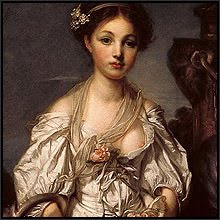
With The Broken Pitcher (below), we see the same subterfuge at work. Anne-Gabrielle, again clothed in satin, was no more likely to have fetched water from the local fountain than she was accustomed to struggle up at four in the morning to milk the lowing herd. But with this subject there is an added frisson of eroticism in the evident (to use today's ludicrously coy term) wardrobe malfunction, and in the pitcher's symbolic suggestion of shattered virginity. This symbolism is enhanced by the position of the clutched hands, and by the blooms cradled in the folds of the dress that will not now receive the water which they need to remain fresh.

When we become aware of these included elements, the seemingly-innocent escapism of The Broken Pitcher gains a darker and more forceful dimension (the detail, below). Seen in this light, it is not so much a portrayal of beauty, as it is of beauty despoiled; not so much a picture of innocence, as of innocence lost. But whose? By all accounts, Anne-Gabrielle was anything but the demure creature that she seems from her husband's canvasses. Rather, her extra-marital sexual escapades, which she apparently took no precaution to conceal either from her husband or from society in general, seem to have driven the artist to despair. Poor Jean-Baptiste. Disillusioned with his marriage, and also with the critique which his attempts at classical subjects prompted from the then all-powerful French Art Academy. Even the small fortune which his successful works generated was squandered by the extravagant frivolities of his wife. But worse was to follow.

To play at being servants and farm labourers when the real labourers were starving was, of course, a recklessly immoral indulgence. A few short years later, the Revolution came to Marie Antoinette's make-believe farm in the palace grounds, and the queen, abandoning her porcelain milk pails and her fragile fantasies, was led away to the guillotine. Unlike the queen and many of her social standing, Greuze avoided losing his head. But he did lose everything else. At age 76 he found himself destitute, with his art being rejected as superficial, sentimental and - that most damning of French adjectives - bourgeois. Jean-Baptiste Greuze died four years later, and was buried with only two mourners in attendance.

Greuze' art went from fashionable demand to scornful rejection, both during his own lifetime and beyond. It seems that only with a certain historical distance can we now see that he in fact succeeded in capturing a specific spirit of his time. That such a spirit had drifted away from harsh social realities was nevertheless something which the artist portrayed in his canvasses, and with hindsight becomes a valid historical statement in itself. And his portrayals of his wife (detail of The White Hat, above) offer images that are at the same time both innocent and coquettish, capricious and mysterious, aloof and alluring, and ultimately enigmatic. And that is art enough.

Well, I had thought to end this particular post with the above statement, but then discovered that New York's Frick Collection has a pastel portrait (detail, above, and below) of Anne-Gabrielle which Greuze painted ten years after The White Hat. Ten years can be a long time in a marriage. A world of difference separates the Anne-Gabrielle portrayed in The White Hat from the Madame Baptiste of 1790.

By 1790 the Revolution had already begun, and the social landscape which formed the basis of Greuze' art was being swept away. But it is the domestic transformation which marks Anne-Gabrielle's expression here. The mystic porcelain beauty of ten years earlier has vanished. In her place Greuze now shows a woman of resigned and weary irony. The sad disillusionment which guided the artist's hand does not make for a comfortable viewing of this sardonic portrait, but it does demonstrate Greuze' accomplishment, both artistic and human, in capturing the painful emotions of his failed relationship. Three years after Greuze painted this bittersweet portrait, and 34 years after he and Anne-Gabrielle married, the couple were finally divorced.


Artist; Jean-Baptiste Greuze
Work: The White Hat, 1780
Medium: Oils
Location: The Museum of Fine Arts, Boston

Artist; Jean-Baptiste Greuze
Work: The Milkmaid, ca. 1770
Medium: Oils
Location: The Louvre, Paris

Artist; Jean-Baptiste Greuze
Work: The Broken Pitcher, 1771
Medium: Oils
Location: The Louvre, Paris

Artist; Jean-Baptiste Greuze
Work: Madame Baptiste, 1790
Medium: Pastels
Location: The Frick Collection, New York

Sources:
The World's Greatest Paintings, Vol. 1, ed. by T. Leman Hare. Odhams Press, Ltd. 1936
Eccentric Spaces, by Robert Harbison. André Deutsch, Ltd. 1977 (for the material about Hameau). Additional biographical information from The Wallace Collection database.

Scan of The White Hat: Harrick. Digitally restored scans of The Milkmaid and The Broken Pitcher: Hawkwood. Madame Baptiste image: The Frick Collection.